
Skip links
View
Drag

COE

Tags

Connecting Manufacturing and Retail Through the Power of AI

In an era of rapid technological advancement, Artificial Intelligence (AI) has emerged as a key driving force in transforming industries—particularly manufacturing, distribution, and retail. According to research by McKinsey, AI has the potential to significantly reduce production costs and greatly enhance operational efficiency. Businesses that integrate AI into their workflows are able to achieve higher profitability while responding more quickly to customer needs and rapidly changing market demands. This article explores how AI plays a critical role in connecting and optimizing the supply chain across manufacturing, distribution, and retail industries, as well as how businesses can leverage AI to improve efficiency, reduce costs, and sustainably enhance customer experience. Understanding the Two Industries  Manufacturing & Distribution This sector involves producing goods from raw materials through to finished products, as well as the movement of goods from manufacturers to markets or end consumers.  Retail Retail focuses on distributing products from retailers to consumers, serving
MFEC

MFEC

Tags

AI-Lab: Transforming Organizations for the Future

Why Organizations Need to Develop Their Own AI  Today, artificial intelligence (AI) models such as ChatGPT, Gemini, and Claude play a significant role in enhancing organizational capabilities and operational efficiency across all industries, while also creating new business opportunities. However, adopting AI within an organization requires careful consideration of several factors, including specific use cases, cost, data security, and technology suitability. As a result, many organizations choose to develop their own AI solutions tailored to their unique needs. The level of AI development can vary, with costs depending on requirements. For example, some organizations have strict data security policies that prevent data from leaving a controlled environment; others require AI systems that integrate seamlessly with internal platforms; while some face high usage volumes that make pay-per-use cloud AI services costly. Organizations can begin developing their own AI by setting clear objectives, starting with specific use cases—such

MFEC

MFEC

Tags

AI Revolution: Uplifting Our Future – Unlocking the Power of AI-Driven Coding

We are committed to empowering our internal teams with the most advanced tools, such as GitHub Copilot, through the session “AI Revolution: Uplifting Our Future” under the topic “AI-Driven Coding Mastery: Unlock GitHub Copilot’s Power.” This initiative brings AI into the development process to help developers work more efficiently, faster, and with greater ease. The session was led by Mr. Thongrit Thongthom (Full Stack Developer) and Mr. Prapawit Duangkaewsansuk (Technical Consultant), who actively tested and applied GitHub Copilot across multiple programming languages. They shared hands-on experiences to demonstrate the real-world benefits and capabilities of using AI in enterprise-level software development.  AI-Powered Coding Across Multiple Languages: The Versatility of GitHub Copilot  GitHub Copilot is an intelligent coding assistant that supports a wide range of programming languages, allowing developers to choose the most suitable language for each project. Key highlights from practical usage include: Python Python is ideal for data processing, especially in Data Science and Machine Learning, supported by a rich ecosystem of libraries. GitHub Copilot suggests relevant commands and reduces

MFEC

MFEC

Tags

AI Revolution: Uplifting Our Future for a Safer Tomorrow

In an era where artificial intelligence has become a core driver of innovation and operations across various industries, at the event AI Revolution: Uplifting Our Future under the theme “AI Is Your Assistant, Not Your Master: Moving Forward Confidently,”our organization is not only committed to delivering AI solutions to our clients, but also to fostering the responsible and secure use of AI within the organization. We emphasize safety by proactively managing potential risks associated with AI adoption and by establishing thoughtful standards for technology usage. At the same time, we are dedicated to empowering our internal teams with the most advanced tools—particularly by leveraging AI to support developers in working more efficiently, faster, and with greater ease. Key Takeaways from the Presentation Deepfake and Synthetic Voice Cloning Techniques : AI is used to create highly accurate fake images and audio, making it easier to exploit these technologies in cyberattacks to

MFEC

MFEC

Tags

Proud to be MFEC: Looknam, Wasuntara Kantayo, Business Development and Partner Alliance

Hello, I’m Wasuntara Kantayo, or Looknam, currently working at MFEC as a Business Development and Partner Alliance in the Information Security team. This year, I had the opportunity to be part of the Cyber Sec Pro project once again, now in its second year.   Cyber Sec Pro was established by the Information Security (InfoSec) team as a valuable opportunity to showcase advanced solutions and insights in cybersecurity. The event not only helps clients understand potential future threats but also builds their confidence in selecting the best technologies and tools to safeguard their organizational data.  I was honored to be entrusted by Mr. Kokanok (Senior Information Security Director) and Mr. Damrongsak (Chief Cyber Security Officer) with the role of Project Manager for the inaugural Cyber Sec Pro event. My role involved coordinating and managing every aspect of the project to ensure its seamless execution and overall efficiency. I was

MFEC

MFEC

Tags

AI Revolution: Uplifting Our Future – Moving Forward with MFEC

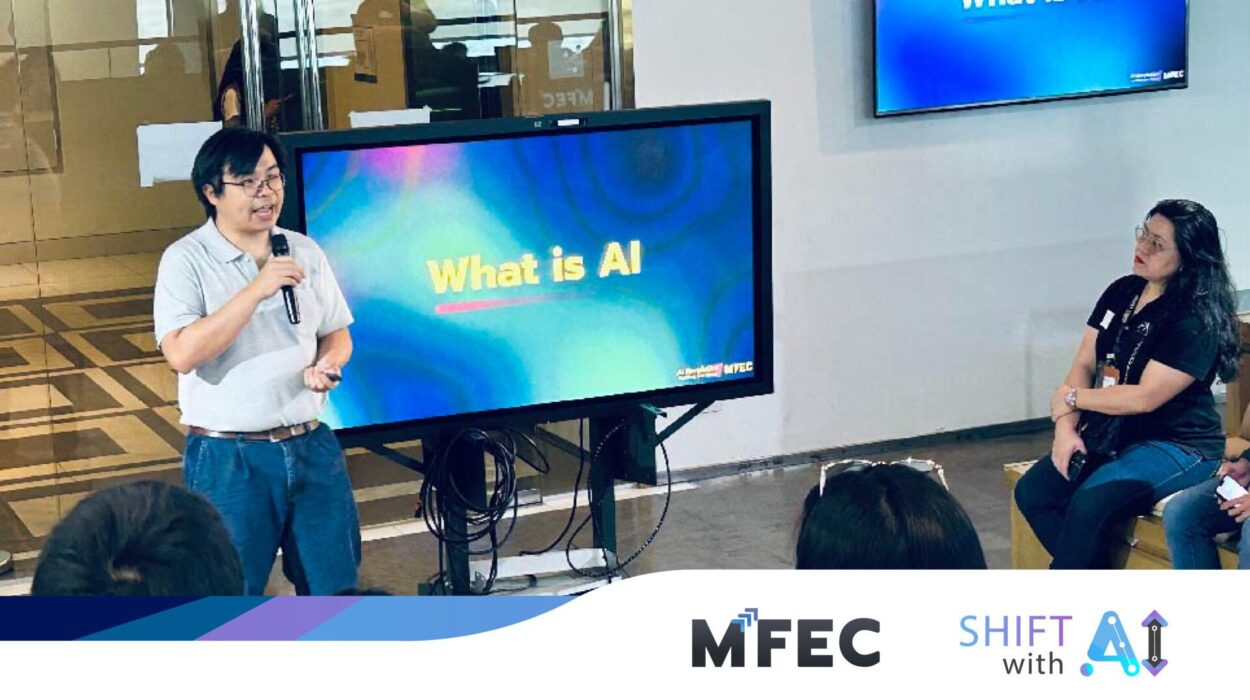
At the AI Revolution: Uplifting Our Future, under the theme “Inside MFEC – Current State and Future Trends,” Mr. Natnaka Sundaranaga (the Head of M-Lab) shared his real-world experiences along with concrete examples of AI implementation within the organization. His presentation showcased the approach to driving AI innovation from within, not merely as a concept or directive, but as a testament to the knowledge, expertise, and tangible efforts of the team’s leading organizational transformation.  Mr. Natnaka highlighted insights from the AI Thailand Conference 2024, detailing MFEC’s structured approach to AI adoption across seven levels. These levels range from foundational understanding to fully embedding AI into every aspect of operations. With most employees equipped to leverage AI in generating complex outcomes, this integration has significantly enhanced both work efficiency and decision-making quality. This tiered framework underscores MFEC’s commitment to developing its people and fostering a learning environment that promotes effective AI

MFEC

MFEC

Tags

AI Revolution: Uplifting Our Future – Smart Data Management for Accurate Decision-Making

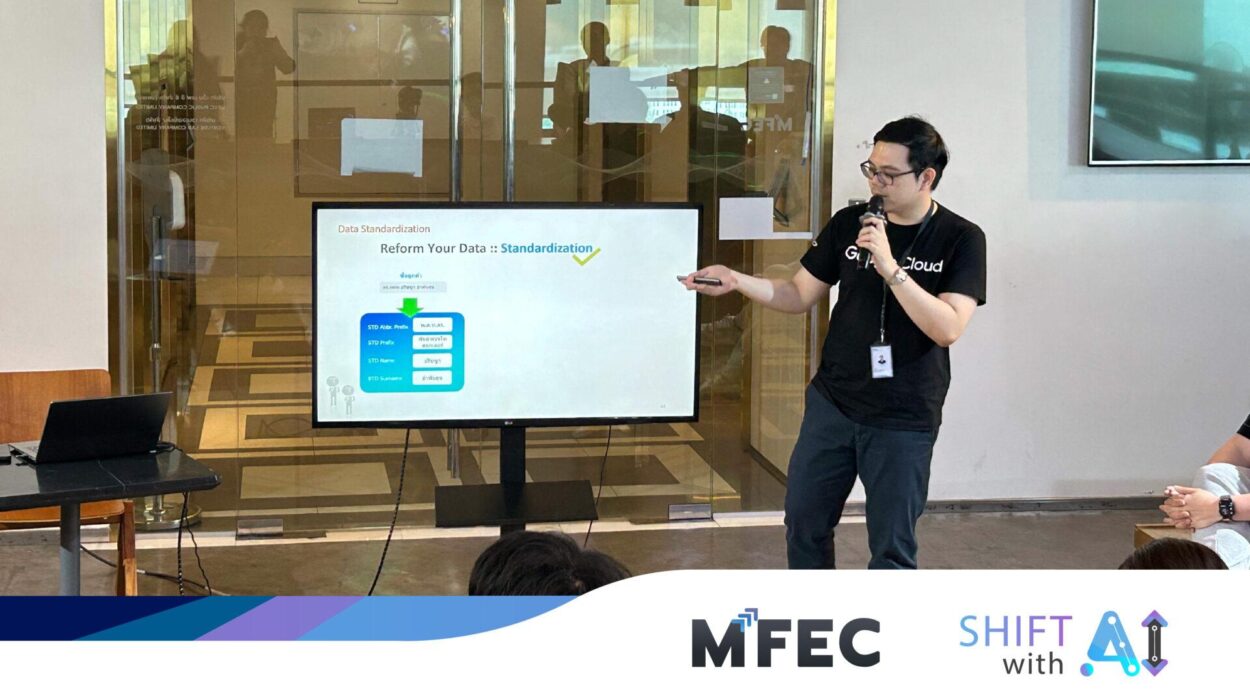
In an era where vast amounts of data flow in from all directions, high-quality and reliable data management has become a crucial factor in business analysis and decision-making. At the event “AI Revolution: Uplifting Our Future,” under the topic “AI Data Revolution: Basic Cleaning Data,” Mr. Sakan Punyanon (Technical Consultant) shared his insights and experiences in Data Cleaning using Generative AI technology, which improves efficiency and minimizes errors in organizational data management.  Mr. Sakan explained the key steps in organizing and cleaning data, from Data Standardization, Data Validation, to handling repetitive tasks with Generative AI. These components are essential for preparing data for in-depth analysis and more accurate business decision-making. He outlined three fundamental AI-powered steps for effective Data Cleaning that can be practically applied to enhance data quality, making it suitable for detailed analysis and precise decision-making: Data Standardization: Mr. Sakan recommended using OpenAI ChatGPT to standardize data from

MFEC

MFEC

Tags

AI Revolution: Uplifting Our Future – From Chatbots to Intelligent Colleagues

From the early days of chatbots to a future where AI evolves into an intelligent assistant and colleague, this seminar, under the theme “Where are we now? What’s Next?”, featured Mr. Wason Liwlompaisan sharing insights into the evolution of AI technology from its origins to the present. He also explored AI’s transformative potential in shaping the future of organizations and society. AI development began in 1966 with Eliza, one of the earliest chatbots created by Joseph Weizenbaum to simulate human conversation. Although it couldn’t truly understand language, Eliza represented a pivotal milestone in human-machine communication. In the late 1960s and 1970s, another significant advancement came with Shakey, the first robot capable of independent thinking and decision-making. Equipped with sensors to analyze its environment and choose its path, Shakey demonstrated AI’s potential for autonomy and logical reasoning. A major milestone that popularized AI occurred in 1997 when IBM’s Deep Blue defeated

MFEC

MFEC

Tags

Is It Really Time for Businesses to Invest in Handling Climate Change?

When discussing climate change from a business perspective, we can’t avoid asking the question: “Is it time to invest in addressing climate change?” “Is our business part of the group that should act now?” “If so, how much budget should we allocate and what should we invest in?” “When should we invest in digital tools to help with this?” Climate change is no longer just about weather-related issues such as rising temperatures, more frequent and severe natural disasters, or simply a “negative impact on the environment.” It has become a major factor that is increasingly affecting businesses across all industries. This is due to the growing enforcement of regulations both in Thailand and in key partner countries worldwide to drive environmental responsibility. There is also rising consumer demand for sustainable products. Additionally, the risks of natural disasters affecting business operations are pushing industries to seriously plan and prepare to address

MFEC

MFEC

Tags

Enhance Professional Customer Service with ServiceNow CSM and Contact Center

In the digital age, where customer needs are at the heart of building strong business-customer relationships, ServiceNow Customer Service Management (CSM) and Contact Center play a crucial role in helping businesses respond to customer demands quickly and accurately, while also enabling teams to manage information effectively. What is ServiceNow CSM?  ServiceNow Customer Service Management, or ServiceNow CSM, is a platform that helps businesses manage customer requests and strengthen relationships through comprehensive services—from service requests and case management to issue resolution. It streamlines customer service processes by providing tools that enhance the efficiency and quality of service delivery.  The Contact Center facilitates the management of customer interactions across various channels, such as phone, email, and chat, ensuring all information is systematically collected and tracked for a more organized and swift service experience.  What Problems Does ServiceNow CSM Solve?  1. Delayed Service  ServiceNow CSM features automatic task assignment to responsible staff,

MFEC

MFEC