
Skip links
View
Drag

TechwithPurpose

Tags

Transforming Sustainability Reporting Challenges with AI and Digital Sustainability

In an era where the world and businesses are increasingly moving toward sustainability, Sustainability Reporting has become a critical foundation that enables organizations to demonstrate their social and environmental responsibility in a transparent and professional manner. This article introduces the concept of Sustainability Reporting, highlights common challenges organizations face, and shares insights on how Digital Sustainability combined with AI can help reduce workload and significantly improve reporting efficiency—through solutions designed by AI experts in collaboration with sustainability professionals who help define standards and validate data quality.  What Is Sustainability Reporting and Why Does It Matter?  Sustainability Reporting is the process of compiling sustainability-related data from all departments within an organization—ranging from finance and marketing to engineering and operations. The main objective is to evaluate the organization’s impact and performance across the three core pillars of ESG (Environmental, Social, and Governance). Benefits of Sustainability Reporting  Enhanced transparency: Builds credibility and trust among stakeholders  Better decision-making: Provides valuable insights for strategic
MFEC

MFEC

Tags

Data & AI: How Two Technologies from MFEC Can Empower Your Business

The Relationship Between Data and AI  Skilled professionals play a crucial role in developing effective Data and AI solutions. Selecting the right platforms and software is essential to ensure worthwhile investment returns and to maximize value for organizations.  Data and AI work together seamlessly. Data serves as the fundamental foundation that AI uses for learning, analysis, and prediction to deliver accurate outcomes. Meanwhile, AI enhances the value of data by transforming raw data into insights, uncovering hidden patterns, and enabling more effective decision-making. AI development operates in a continuous cycle, as AI models can improve themselves with new data, making systems increasingly accurate and intelligent. “AI requires large volumes of high-quality data to learn and analyze accurately, while data needs the intelligence of AI to fully extract value from massive datasets.”  What Is Data Quality and Why Is It Important?  High-quality data enables businesses to compete effectively, deliver

MFEC

MFEC

Tags

Business solution consultant service & Low code platform

In 2025, when discussing the rapidly growing trend of Artificial Intelligence (AI), it is impossible to overlook Agentic AI—a technology that has gained significant attention since late 2024. Both now and in the future, Agentic AI will play a critical role in deep operational work, decision-making, and adapting to the increasing complexity of today’s fast-changing business landscape. We invite you to explore Agentic AI and discover how MFEC’s professional consulting services empower organizations to achieve success in the digital era. What Is Agentic AI?  Agentic AI refers to artificial intelligence that operates autonomously, similar to a virtual assistant. It can think, analyze, make decisions, and learn independently to achieve specific goals—without requiring constant human guidance.  Today, enterprise IT systems face multiple challenges, including: Limitations of legacy systems Complexity in system maintenance High operational costs Products reaching End-of-Life (EOL) As a result, system transformation and optimization have

MFEC

MFEC

Tags

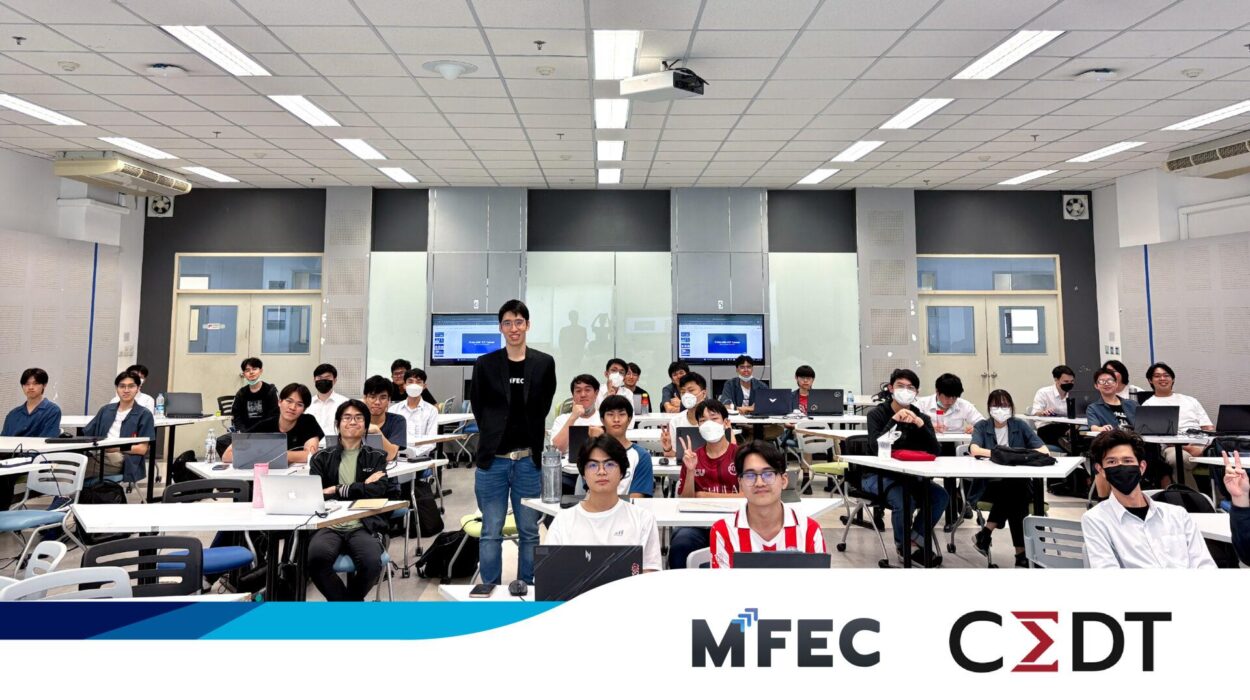
MFEC Shares Knowledge on “IoT & Smart Solution and Career”

Mr. Ittikorn Anantawanitchaya (Pond), IoT and Smart Solution Business Development at MFEC, had the opportunity to share his expertise in IoT with students from the Department of Computer Engineering and Digital Technology, Chulalongkorn University, under the topic “IoT and Smart Solution and Career.” The session highlighted the importance and benefits of IoT technologies across both factory and non-factory industries, helping students understand how IoT is applied in real-world business and industrial environments. In addition, the talk emphasized IoT Security, raising awareness of the critical role that security plays in IoT implementations. Real-life IoT use cases involving everyday devices were also shared to provide clearer insights and enhance students’ understanding through practical examples. The session concluded with career guidance in the IoT field, offering students valuable advice to help them explore their interests and prepare for future growth in IoT-related careers. Students who are interested in internships are invited

MFEC

MFEC

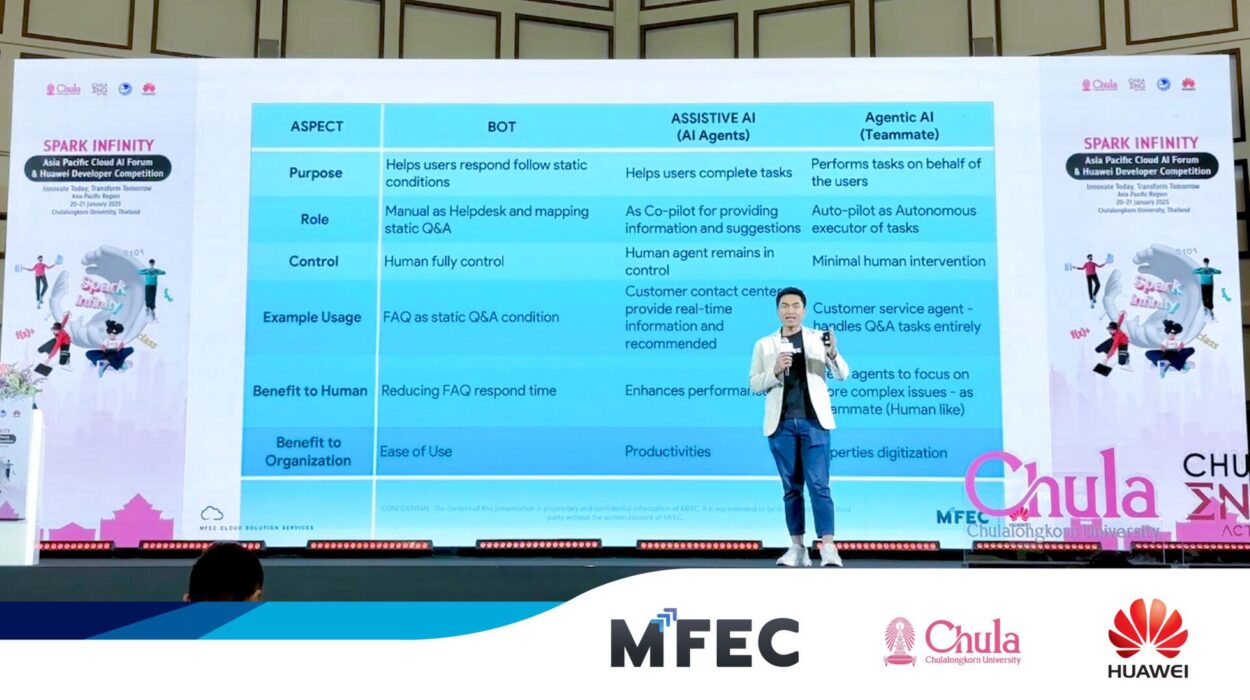
MFEC Invited to Participate in the Asia Pacific Cloud AI Forum & Huawei Developer Competition

Huawei Technologies (Thailand) Co., Ltd., in collaboration with Chulalongkorn University, hosted the Asia Pacific Cloud AI Forum & Huawei Developer Competition at Chulalongkorn University. The event aimed to showcase the latest technologies on Huawei platforms and to support the development of students and organizations by enhancing their expertise in Huawei Innovation through solution presentations and designs built on Huawei technologies.  Mr. Direk Yimlamai (Tuah), Cloud Solution Director at MFEC, was invited as a guest speaker to represent MFEC in the session “Thailand’s AI and Cloud Outlook 2025.” His presentation focused on the importance of AI and its integration into everyday life to better align with the demands of the modern era. “Today, Agentic AI is one of the latest advancements in the AI landscape. It enables AI to possess greater knowledge and intelligence in its responses—for example, adapting content and context to suit individual users, or analyzing conversations dynamically based on different situations. We have now

MFEC

MFEC

Tags

Connecting Manufacturing and Retail Through the Power of AI

In an era of rapid technological advancement, Artificial Intelligence (AI) has emerged as a key driving force in transforming industries—particularly manufacturing, distribution, and retail. According to research by McKinsey, AI has the potential to significantly reduce production costs and greatly enhance operational efficiency. Businesses that integrate AI into their workflows are able to achieve higher profitability while responding more quickly to customer needs and rapidly changing market demands. This article explores how AI plays a critical role in connecting and optimizing the supply chain across manufacturing, distribution, and retail industries, as well as how businesses can leverage AI to improve efficiency, reduce costs, and sustainably enhance customer experience. Understanding the Two Industries  Manufacturing & Distribution This sector involves producing goods from raw materials through to finished products, as well as the movement of goods from manufacturers to markets or end consumers.  Retail Retail focuses on distributing products from retailers to consumers, serving

MFEC

MFEC

Hospital Application: Enhancing Access to Healthcare Services for Thai

What is a Hospital Application?  A Hospital Application is a mobile application designed to assist patients and hospitals in managing medical information and healthcare services. Its primary goal is to improve convenience and efficiency in patient care. Features That Enhance Convenience for Patients in the Digital Era  Online Appointment Booking Patients can easily schedule, view, reschedule, or cancel appointments online, reducing waiting time and making healthcare services more accessible.  Telemedicine Patients can consult with doctors remotely for non-complex conditions, follow-ups, or medication guidance, saving time and avoiding unnecessary hospital visits.  Queue Tracking Patients can monitor real-time queue status through the app or website, reducing anxiety and helping manage their time more effectively.  Health Record Access Digital access to medical history, prescriptions, and lab results allows patients to check essential health information anytime, anywhere.  Automated Notifications The system can send reminders for appointments, medication intake, or health check-ups to help patients stay on track with their healthcare routines. 

MFEC

MFEC

Tags

AI-Lab: Transforming Organizations for the Future

Why Organizations Need to Develop Their Own AI  Today, artificial intelligence (AI) models such as ChatGPT, Gemini, and Claude play a significant role in enhancing organizational capabilities and operational efficiency across all industries, while also creating new business opportunities. However, adopting AI within an organization requires careful consideration of several factors, including specific use cases, cost, data security, and technology suitability. As a result, many organizations choose to develop their own AI solutions tailored to their unique needs. The level of AI development can vary, with costs depending on requirements. For example, some organizations have strict data security policies that prevent data from leaving a controlled environment; others require AI systems that integrate seamlessly with internal platforms; while some face high usage volumes that make pay-per-use cloud AI services costly. Organizations can begin developing their own AI by setting clear objectives, starting with specific use cases—such

MFEC

MFEC